
By: Ilana Mittleman
The FIFA World Cup kicked off on June 11th with foreign and domestic audiences alike descending upon host cities to root for their own countries. Like many American cities, Philadelphia swelled recently with increased foot traffic and international fans.
While historically a landmark international event, U.S. World Cup viewership has typically lagged other nations. According to S&P Global, nearly 50% of UK online adults report viewing the World Cup compared with just 13% in the United States. To put this in perspective, the 2022 Super Bowl attracted more than 99 million in the U.S., while the 2022 World Cup reached 26 million across Fox and Telemundo. Americans, it seems, overwhelmingly favor a version of football that includes end zones and touchdowns.
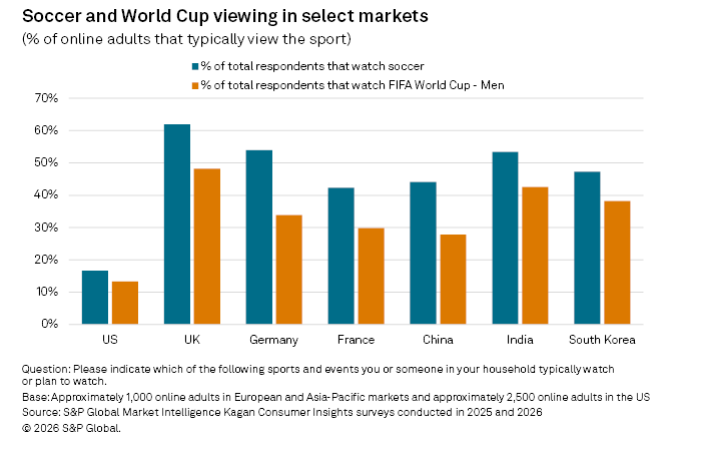
The international presence and fervor in the U.S., however, may be signaling a change
Nielsen has reported record-breaking U.S. viewership throughout the 2026 World Cup. On June 12th, Americans swarmed local bars in droves to catch the USNMT’s first match against Paraguay. The game received an average of 25 million viewers across Fox, Telemundo and their streaming platforms. It was, according to Nielsen, one of the highest viewed soccer games broadcast in the United States to date.
Interest has held strong since then. Matches against Australia and Turkey surpassed 22 million viewers each, with audiences that rivaled many NBA and MLB championship games. Even more telling, Americans are watching more than their own team. Fox reported that the group-stage matches averaged just over 5 million viewers across the 72 games, a record setting U.S. audience and +92% over 2022.
Momentum finally peaked during the USNMT’s final match against Belgium. Viewership spiked at 50.1 million during the game. According to Michael Mulvihill, President of Insights and Analytics at FOX, the game was the most-watched non-NFL sports event in the U.S. since the 1994 Winter Olympics. And on July 21st, Fox announced that the Spain vs. Argentina World Cup final match reached more than 62 million U.S. viewers across Fox, Telemundo, and Peacock. The number exceed all NFL games for the 2025 season except the Super Bowl.
Maybe Scottish fans drinking Boston’s bars dry have had an impact on American viewers
So, what does this mean for advertisers? Soccer offers a unique opportunity to reach a loyal and engaged fanbase. If viewership continues to hold beyond the 2026 World Cup, soccer presents another opportunity to gain broad-based reach and awareness among Americans.
Live sports have been a mainstay of linear TV, with the Super Bowl and NBA championship offering massive and unprecedented reach, though soccer has traditionally trailed in viewership. With the momentum from the World Cup and the U.S. soccer viewership climbing, advertisers have the opportunity to enter the market early before messaging becomes cluttered. Brands that enter earlier will establish increased trust and familiarity with fans.
Beyond viewership data, soccer has recently overtaken baseball as American’s third favorite sport, a trend which would likely translate into increased engagement from fans. While the Super Bowl remains very popular, it’s possible that Americans will soon prefer a football that includes nets and goalies. The 2030 FIFA World Cup data will be very telling.